U.S. Missile Production to Rise With New Solid Rocket Motor Facility
10/26/2026 / By Garrison Vance

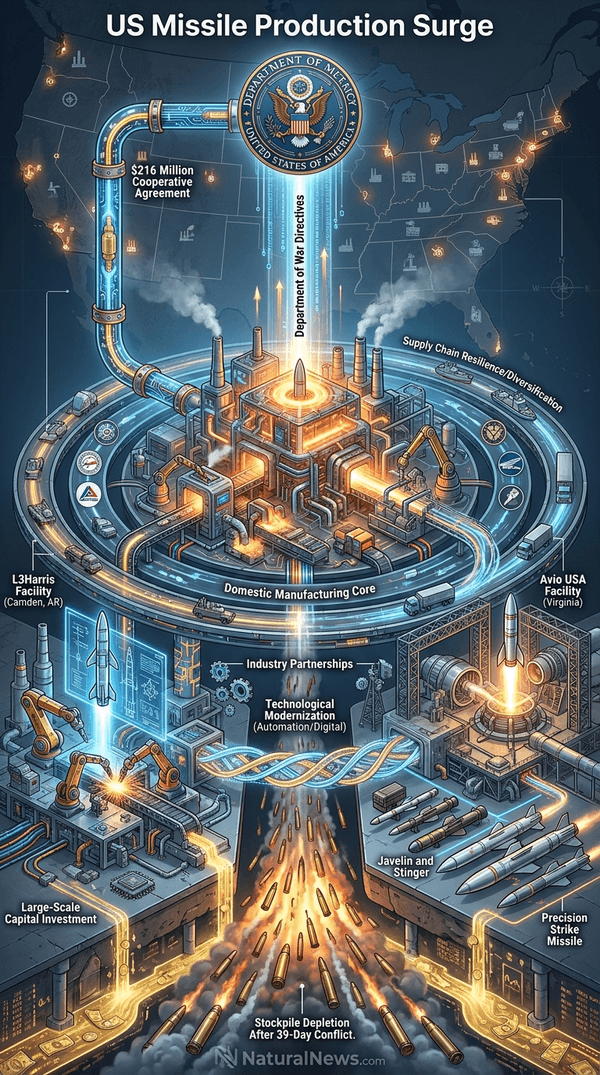
L3Harris Technologies opened a next-generation solid rocket motor production facility in Camden, Arkansas, on Oct. 20, 2026, a move the company said is designed to double its current solid rocket motor capacity and add further growth potential [1]. The company said the new facility, together with additional propellant processing infrastructure, will support production for tactical missiles used by the U.S. military [2][3].
The opening is part of a broader expansion of the domestic solid rocket motor industrial base. The $216 million cooperative agreement L3Harris signed with the Department of War in 2023 covers increased demand for tactical missiles including Javelin and Stinger, according to the company [3]. The U.S. Army has also used the Camden facility’s output to support the Guided Multiple Launch Rocket System, according to a defense industry report [4].
Separately, Avio USA broke ground on its first U.S. solid rocket motor manufacturing facility — an approximately 900,000-square-foot plant in Hurt, Virginia — on Oct. 6, 2026 [5]. That facility is expected to produce thousands of solid rocket motors annually, with production scheduled to begin in early 2029, according to the company [6].
Existing Production Constraints and Demand
The expansion follows sustained pressure on the solid rocket motor supply chain. Northrop Grumman has invested more than $1 billion in its solid rocket motor propulsion manufacturing facilities across the United States, according to the company [7]. The U.S. Navy awarded Ursa Major $137 million to develop solid rocket motors for two missile programs as the service works to expand missile production capacity, according to a defense publication [8].
The Department of War has pressed weapons contractors to accelerate output.
The demand pressure stems in part from recent combat consumption. During a 39-day war with Iran, the United States used so many key offensive and defensive weapons that rebuilding some stocks to pre-war levels will take three or more years, according to a Center for Strategic and International Studies report compiled by Mark F. Cancian and Chris H. Park.
Facility Details and Planned Capacity
L3Harris said the Camden facility centralizes production of the solid rocket motors used for surface-to-surface precision fires capability [3]. Avio USA’s Virginia plant is designed to support design, assembly and testing activities, and to reinforce supply chain resilience for U.S. missile programs, according to a company report [9]. The Virginia facility is being developed to support solid rocket motor requirements across the U.S. defense industry, including programs for Lockheed Martin and Raytheon [10].
Industry partnerships are part of the planned capacity build-out. Lockheed Martin and Avio announced a strategic cooperation agreement on Oct. 13, 2026, for the production of solid rocket motors [11]. After qualification, initial work will focus on producing solid rocket motors for the Extended Range GMLRS and the Precision Strike Missile, with production to be performed at Avio USA’s new facility in Hurt, Virginia, drawing on its parent company’s solid propulsion expertise [12]. Seeking Alpha reported that the agreement aims to boost missile output and ease supply constraints [13].
Ken Bedingfield, president of missile solutions at L3Harris, said the Camden facility reflects the company’s broader effort to expand solid rocket motor manufacturing by combining automated equipment, digital processes and skilled workers [14].
Statements From Officials and Industry
A defense official said the facility is intended to reduce reliance on limited suppliers and to meet current and future demand, according to the announcement.
Industry representatives have pointed to a need to modernize production capacity.
No independent verification of production timelines was provided. The cost and exact location of some associated investments were not disclosed in the statements reviewed for this article.
Next Steps and Oversight
The Department of War said it will continue to assess production milestones, according to the announcement. Congressional committees have requested updates on missile production rates, officials said.
Further details on cost and location were not disclosed, the report stated.
As the industrial base expands, the central question is whether the new capacity can be brought online fast enough to address demand.
References
- L3Harris Opens Next?Generation Solid Rocket Motor …. https://www.l3harris.com/newsroom/press-release/2026/10/l3harris-opens-next-generation-solid-rocket-motor-facility-boost
- US’ tactical missiles production to get major boost with next-gen solid …. https://article.wn.com/view/2026/10/22/US_tactical_missiles_production_to_get_major_boost_with_next/
- L3Harris Opens Next?Generation Solid Rocket Motor Facility to Boost …. https://www.barchart.com/press-releases/8248238/l3harris-opens-nextgeneration-solid-rocket-motor-facility-to-boost-production-capacity
- L3Harris opens Arkansas rocket motor plant designed to double …. https://defence-industry.eu/l3harris-opens-arkansas-rocket-motor-plant-designed-to-double-production-capacity/
- Avio USA Breaks Ground in Virginia on First U.S. Solid Rocket Motor …. https://www.accessnewswire.com/newsroom/en/aerospace-and-defense/avio-usa-breaks-ground-in-virginia-on-first-u.s.-solid-rocket-motor-facility-1233587
- Avio USA Starts Building Plant to Power US Missile Boom. https://thedefensepost.com/2026/10/01/avio-usa-missile-motor-plant/
- Solid Rocket Motors. https://www.northropgrumman.com/who-we-are/the-facts/solid-rocket-motors-propulsion
- solid rocket motor. https://thedefensepost.com/tag/solid-rocket-motor/
- Avio Plans $500M US Solid Rocket Motor Facility – The Defense Post. https://thedefensepost.com/2026/02/25/avio-virginia-rocket-facility/
- Avio USA Breaks Ground in Virginia on First U.S. Solid Rocket Motor …. https://www.morningstar.com/news/business-wire/20260929357378/avio-usa-breaks-ground-in-virginia-on-first-us-solid-rocket-motor-facility-strengthening-defense-supply-chain-and-creating-over-1000-jobs
- Lockheed Martin and Avio Announce …. https://news.lockheedmartin.com/2026-10-13-Lockheed-Martin-and-Avio-Announce-Strategic-Cooperation-Agreement-for-Solid-Rocket-Motor-Production
- Media – Lockheed Martin – Releases. https://news.lockheedmartin.com/2026-10-13-Lockheed-Martin-and-Avio-Announce-Strategic-Cooperation-Agreement-for-Solid-Rocket-Motor-Production?asPDF=1
- Lockheed Martin, Avio agree to expand U.S. rocket motor production. https://seekingalpha.com/news/4652617-lockheed-martin-avio-agree-to-expand-u-s-rocket-motor-production
- L3Harris Opens Solid Rocket Motor Facility in Arkansas. https://www.executivebiz.com/articles/l3harris-solid-rocket-motor-facility
Explainer Infographic
Submit a correction >>
Tagged Under:
Arkansas, ballistic missiles, big government, future tech, ground-based missiles, L3Harris Technologies, manufacturing, military tech, missile production, national security, progress, solid rocket motor, supply chain, tactical missiles, weapons production, weapons technology
This article may contain statements that reflect the opinion of the author
RECENT NEWS & ARTICLES